 Life Science
 Healthcare
 Services
 Manufacturing

 Logistics
  Life Science
  Healthcare
 Services
 Manufacturing
  Banking & Finance
 Retail
 E-Commerce
 Finance
 Supply Chain Management
 Sales
Sales Customer Service
 Field Service
 Project Operation
 Marketing
 Human Resources
 Business Central
 Power BI
 Power Apps
 Power Automate
 Power Virtual Agents
 AI Builder
 Machine Learning
 Data Integration
 Data Warehousing
 Data Analytics
 Data Visualization
 Data Governance
 Big Data
 Looker Studio
 Data Machine Learning
 Prediction & Forecasting
 BOTs & Virtual Agent
 Language Services
 Generative AI
 Agentic AI
 iOS & Android Development
 Cross-Platform Development
 UI/UX Design
 App Testing & QA
 Backend Development
Cloud ERP vs Legacy ERP: A Smart Guide
In today’s fast-changing digital world, sticking with old systems can hold your business back. ERP systems are crucial for running modern companies, but not all of them work the same way. Moving from an old Legacy ERP to a Cloud ERP isn’t just changing technology—it’s a shift that can improve how efficiently you work, how easily you grow, and even your profits.
At Key Dynamics Solutions, we guide & help companies through this change so they can get the most from new ERP technology.
Let’s look at how Cloud ERP and Legacy ERP really affect business.
What’s Legacy ERP?
Legacy ERP refers to traditional systems installed on local servers, needing your own IT staff and equipment. These worked well before but often struggle to meet today’s business needs.
Key points:
- Installed on company servers
- High upfront cost for hardware
- Updates and maintenance done manually
- Hard to scale up
- Limited access outside the office
What’s Cloud ERP?
Cloud ERP runs on the internet, hosted on secure cloud platforms. It lets you access it anytime from any device and links easily with other tools.
Key points:
- Hosted on the cloud
- Subscription pricing
- Automatic updates
- Scales easily as you grow
- Access from anywhere
-
Costs: Big Investment vs Pay-As-You-Go
Legacy ERP demands a big initial investment in hardware and licenses with maintenance and downtime, and costs keep rising continuously.
Cloud ERP works on a subscription model in which there is no big upfront spending. Business owners can pay based on what they need, which can save lot of money.
Business results:
- Lower IT hardware costs
- Predictable monthly bills
- Less work maintaining the system
-
Growth & Flexibility
Old systems are tough to expand—adding users or new locations means buying more equipment and spending more time.
Cloud ERP is built to grow with you. Adding users or services happens quickly and smoothly.
Business results:
- Faster expansion
- Easier to adjust with market changes
- No restrictions holding back growth
-
Access & Remote Work
Since remote work became common, being able to access your ERP from anywhere is key.
Legacy ERP usually works only in the office, making flexible work harder.
Cloud ERP provides secure access wherever you are, helping teams stay connected.
Business results:
- Higher productivity
- Remote teams work smoothly
- Real-time teamwork
- Data-Driven Decisions
Old systems often keep data isolated, with slow reporting. Decisions become reactive.
Cloud ERP delivers real-time dashboards and AI-based insights, so you can make smarter choices quickly in less time.
Business results:
- Faster, better decisions
- Up-to-date operational visibility
- Improved forecasting
-
Integration & Automation
Legacy systems generally don’t connect well with other tools, leading to time consuming manual data entry and more mistakes.
Cloud ERP links easily with CRM, HR, finance, and automates routine tasks with can save time and reduce mistakes.
Business results:
- Better efficiency
- Fewer errors
- More streamlined work
-
Security & Compliance
Many think on-site systems are safer, but old ERP may lack current security protocols and delayed updates.
Cloud ERP providers focus heavily on security, using encryption and regular updates.
Business results:
- Stronger data protection
- Meets industry rules
- Lower risk of breaches
-
Faster Setup & Updates
Installing Legacy ERP can take a long time and disrupt work.
Cloud ERP is quicker to deploy and updates happen automatically.
Read more: Running Your Business on Autopilot: The Future of ERP Automation
Business results:
- Faster benefits
- Less downtime
- Continuous improvements
- Business Continuity
Legacy ERP generally depends on hardware, vulnerable to failures or disasters.
Cloud ERP includes backup and disaster recovery to keep your business running.
Business results:
- Less data loss risk
- Quick recovery from issues
- Reliable operations
Quick Comparison
Legacy ERP has high startup costs with limited access, tough scaling, manual updates, poor integration, and slow deployment.
Cloud ERP uses subscriptions which can be accessible anywhere, easy to scale, updates automatically, integrates well, and deploys quickly.
| Feature | Legacy ERP | Cloud ERP |
| Cost Model | High upfront cost | Subscription-based |
| Accessibility | Limited | Anywhere, anytime |
| Scalability | Difficult | Easy and flexible |
| Updates | Manual | Automatic |
| Integration | Limited | Seamless |
| Deployment Time | Long | Quick |
Why Companies Are Moving to Cloud ERP
Businesses need systems that can adapt fast, give real-time insights, and support digital shifts with low cost.
Cloud ERP helps companies:
- Stay competitive
- Improve customer experience
- Work more efficiently
- Innovate with AI and automation
Why Choose Key Dynamics Solutions?
We help businesses switch to Cloud ERP smoothly and with little disruption.
Our services include:
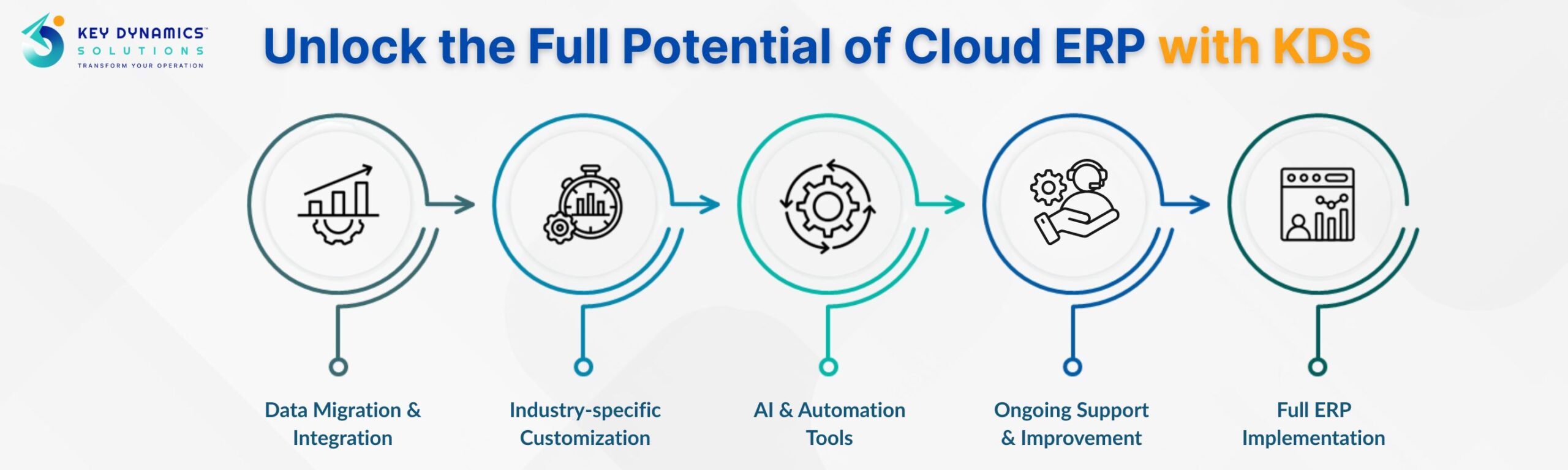
- Full ERP implementation
- Data migration and integration
- Industry-specific customization
- Ongoing support and improvement
- AI and automation tools
Read more: How AI Agents in Business Central Are Revolutionizing ERP Automation
We make sure your move to Cloud ERP unlocks its full potential.
Final Thoughts
The choice between Cloud and Legacy ERP isn’t just about tech—it’s about growing your business and being ready for the future.
While Legacy ERP might have worked before, it struggles with today’s demands. Cloud ERP offers a more flexible, faster, and smarter way to run your operations.
If your current system is holding you back, it’s worth reconsidering your ERP strategy.
Ready to Upgrade?
Switch to Cloud ERP with Key Dynamics Solutions and enjoy:
- Better efficiency
- Real-time insights
- Easy growth
- Operations built for tomorrow
Let’s leave the limits behind and innovate together.