 Life Science
 Healthcare
 Services
 Manufacturing

 Logistics
  Life Science
  Healthcare
 Services
 Manufacturing
  Banking & Finance
 Retail
 E-Commerce
 Finance
 Supply Chain Management
 Sales
Sales Customer Service
 Field Service
 Project Operation
 Marketing
 Human Resources
 Business Central
 Power BI
 Power Apps
 Power Automate
 Power Virtual Agents
 AI Builder
 Machine Learning
 Data Integration
 Data Warehousing
 Data Analytics
 Data Visualization
 Data Governance
 Big Data
 Looker Studio
 Data Machine Learning
 Prediction & Forecasting
 BOTs & Virtual Agent
 Language Services
 Generative AI
 Agentic AI
 iOS & Android Development
 Cross-Platform Development
 UI/UX Design
 App Testing & QA
 Backend Development
Introduction
The present digital environment demands that companies find methods to enhance operational productivity while decreasing operational expenses and achieving expedited business expansion. However, organizations continue to depend on manual work methods which use separate technology systems and require extensive time commitments for their tasks which hamper their ability to expand their operations.
Imagine your company could operate without any human intervention.
ERP automation enables businesses to transform their existing operational methods into advanced automated systems which use artificial intelligence and intelligent workflow systems to function independently.
What is ERP Automation?
ERP (Enterprise Resource Planning) automation works on AI and machine learning and workflow automation technologies to amplify and automate business operations.
The ERP system performs repetitive and manual work without human input, which leads to time savings and lesser mistakes and better work efficiency with improved quality.
The ERP system integrates all business operations from finance and supply chain management to sales and customer support into a single cohesive framework.
Why Businesses Need ERP Autopilot?
The present-day business environment presents organizations with a set of challenges which they must solve.
- Manual data entry and repetitive tasks
- Delayed decision-making due to lack of real-time data
- Disconnected systems causing inefficiencies
- High chances of human errors
These issues take more time & also impact productivity and growth.
By adopting ERP automation, businesses can move from reactive operations to proactive, intelligent decision-making.
How ERP Automation Works?
The ERP automation system uses a structured workflow to execute business operations without interruptions.
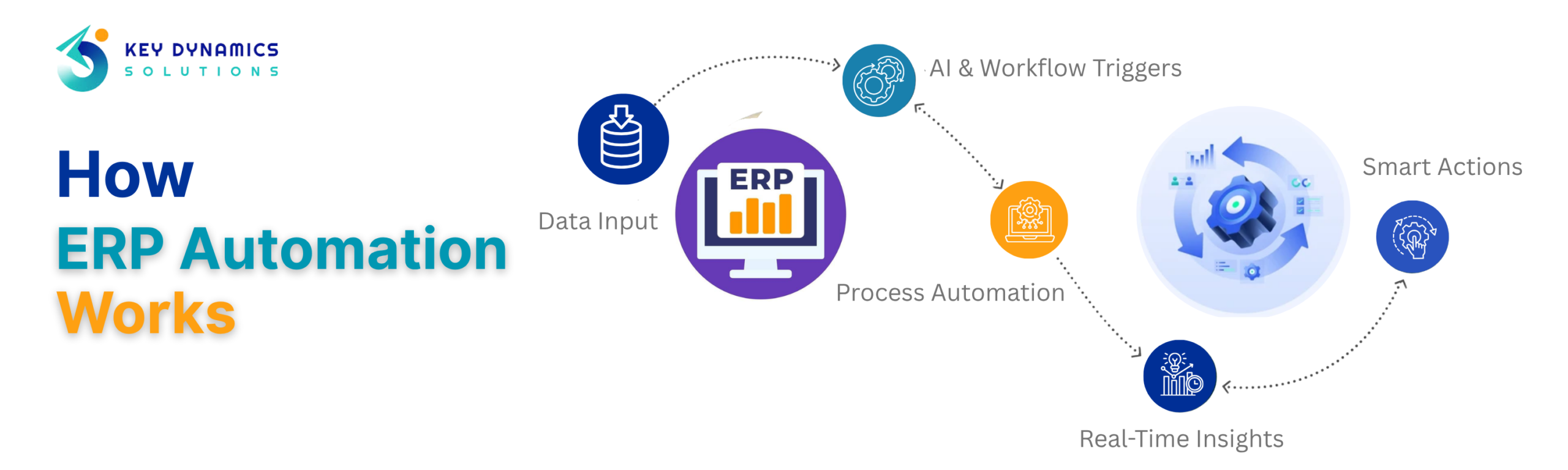
- Data Input – The system gathers data from multiple sources which include ERP systems and CRM platforms, and external applications.
- AI & Workflow Triggers – Automated workflows get activated when the system analyzes data through AI models and predefined rules.
- Process Automation – The system performs automatic execution of tasks which includes approvals and notifications and reporting, and updates.
- Real-Time Insights – The dashboards deliver current data together with analytical tools to enhance understanding of the situation.
- Smart Actions – The system recommends or executes actions by using data insights which help users make quick and intelligent choices.
The business operation process needs this flow because it enables companies to function with high efficiency while needing less manual work.
Read more about: Cloud ERP vs Legacy ERP: What Really Matters for Your Business
Key Benefits – Running Your Business on Autopilot
- Increased Efficiency – Teams can dedicate their time to strategic work because automation removes repetitive work tasks from their jobs.
- Faster Decision-Making – Businesses utilize real-time data together with insights to create faster and better decisions.
- Reduced Errors – Automated processes reduce human errors, which leads to improved accuracy and reliability.
- Cost Savings – Businesses can achieve major cost reductions through two methods, which include decreasing manual tasks and boosting operational efficiency.
- Improved Productivity – Employees can dedicate their time to essential work instead of performing standard tasks.
- Scalability – ERP automation enables businesses to expand their operations while maintaining operational simplicity.
Key Capabilities of ERP Automation
Modern ERP systems offer powerful capabilities that drive business transformation:
- Task Automation: The system automates all tasks which need repetitive work and follow predetermined rules.
- Workflow Automation: The system enables users to design smart workflows which connect different departments.
- Real-Time Analytics: Users can view live dashboards together with their corresponding reports.
- Integration: The system enables users to link different software systems and applications.
- AI-Powered Insights: The system provides predictive insights of your business which helps users plan their activities.
Key Capabilities We Deliver
At Key Dynamics Solutions, we empower businesses with:
- Automated Workflows for seamless operations
- Real-Time Dashboards for better visibility
- AI-Powered Insights for smarter decisions
- System Integrations to unify business processes
- Custom ERP Solutions tailored to your needs
These capabilities help businesses achieve operational excellence.
Tools Behind ERP Autopilot
We leverage industry-leading technologies to build intelligent ERP systems:
- Microsoft Dynamics 365 ERP & CRM
- Power Automate for workflow automation
- Power BI for real-time analytics
- Microsoft Copilot & Azure OpenAI for AI capabilities
- Power Platform for custom app development
Together, these tools can create a powerful ecosystem for business ERP automation.
ERP Automation Across Industries
Our ERP automation solutions serve to various industries:
- Manufacturing: Optimize production and inventory
- Retail: Streamline orders and customer management
- Healthcare: Improve compliance and data handling
- Finance: Automate reporting and financial processes
- Logistics: Enhance tracking and delivery operations
No matter the industry, ERP automation drives efficiency and growth.
Challenges in Implementing ERP Automation
ERP automation provides multiple advantages. However, businesses encounter different obstacles which include these factors:
- Resistance to change from employees
- Integration with legacy systems
- Initial implementation costs
- Data migration complexities
The two obstacles become manageable through expert guidance which follows a successful strategy.
The Future of ERP: AI-Driven Autopilot
AI-based automated systems will take over ERP functions through their capacity to execute tasks and continuously learn.
Business will benefit from these AI developments which will bring:
- Predictive analytics for better forecasting
- Intelligent assistants for decision support
- Fully automated workflows with minimal human input
- Enhanced personalization and customer experiences
ERP systems are evolving from management tools to intelligent business partners.
Read more about: How AI Agents in Business Central Are Revolutionizing ERP Automation
How to Get Started with ERP Automation?
The first steps to start with ERP automation require you to evaluate your current processes and determine which areas need automation. The appropriate ERP platform selection needs to include all necessary tools.
You must create structured operational procedures together with system automation specifications.
- The project requires you to complete data transfer activities together with system link establishment.
- Your team requires training to achieve successful system acceptance.
A solution provider with industry experience will help you complete your project more quickly and efficiently.
Conclusion
Today businesses can operate their organizations through automatic systems which were once considered a future possibility. ERP automation lets organizations become more efficient because it removes time-consuming tasks and provides advanced decision-making capabilities. Businesses that implement ERP automation will obtain a major competitive edge because technology keeps advancing.
With ERP automation, businesses can eliminate manual processes, improve efficiency, and make smarter decisions.
At Key Dynamics Solutions, we empower organizations to embrace automation and unlock their full potential.
In case you need any assistance please feel free to call us at +91 9217719348 or simply send us an email at Sales@keydynamicssolutions.com