 Life Science
 Healthcare
 Services
 Manufacturing

 Logistics
  Life Science
  Healthcare
 Services
 Manufacturing
  Banking & Finance
 Retail
 E-Commerce
 Finance
 Supply Chain Management
 Sales
Sales Customer Service
 Field Service
 Project Operation
 Marketing
 Human Resources
 Business Central
 Data Integration
 Data Warehousing
 Data Analytics
 Data Visualization
 Data Governance
 Big Data
 Looker Studio
 Power BI
 Power Apps
 Power Automate
 Power Virtual Agents
 AI Builder
 Data Machine Learning
 Prediction & Forecasting
 BOTs & Virtual Agent
 Language Services
 Generative AI
 Agentic AI
 iOS & Android Development
 Cross-Platform Development
 UI/UX Design
 App Testing & QA
 Backend Development
Introduction
In the world that is rapidly changing digitally, the successful ERP and business software implementations rely on the most important phase of requirements gathering and analysis, which has been traditionally performed manually and requires a lot of time and is open to user interpretation mistakes. The stakeholders often provide redundant feedback on the meeting notes, and it takes weeks or even months to translate a current business need into a set of organized, workable requirements.
To solve these issues, Key Dynamics Solutions is helping businesses transform ERP with intelligent AI agents. Meet AI-Enabled Agent 1, AI-Powered Discovery & Analysis– a smart requirements Intelligence tool that combines the latest language models with automation to transform unstructured meeting inputs into structured, prioritized, and ready-to-drive outcomes sets of requirements. It is a massive leap forward in accelerating the pace of digital transformation while guaranteeing the accuracy, consistency, and traceability of requirements.
The Issue: The Limitations of Traditional Requirements Gathering
- Requirements gathering process is the most important factor in the success of any ERP or Business System Implementation – however, organizations experience several requirements gathering challenges:
- Stakeholder input is from multiple sources (e.g., meetings, emails, documents). This approach is guaranteed to miss and misinterpret requirements.
- Duplicate/conflicting requirements cause confusion; Translation of business linguistics to tasks for technical implementation is labor-intensive
- Limited traceability means there is no easy way of tracking the evolution of requirements over time.
These challenges do not only slow down implementation timelines but also place the projects at risk of delay, scope creep, and a mismatch between business expectations and delivered solutions.
Agent 1 eliminates these limitations by bringing automation, intelligence, and structure to the requirements of the discovery process.
How Agent 1 Works: Intelligent Requirements Extraction?
1st Agent employs AI models of various stages to analyze the transcript generated following the meetings with the client and over workshops or discussions with the user and stakeholder sets.
Instead of relying on manual interpretation, the agent automatically performs natural language processing and structures it into requirements.
Step 1: Meeting Transcript Analysis
The first agent starts with analyzing raw meeting transcripts of workshops, discovery sessions, or stakeholder meetings.
Such transcripts may be;
- Business process talks
- User pain points
- Feature Request
- Operational issues
- Functional Expectations
Step 2: Automated Summarization and Key Insight Extraction
One of the agent’s core competencies is summarization.
- Key business needs
- Functional requirements
- Operational Challenges
- Expected system outcomes
The implementation teams do not have to watch hours of meeting recordings or go through lengthy documents, but instead, they get concise, structured summaries. These accelerate analysis time dramatically while providing clarification.
Step 3: Identification of Business Domains and User Personas
Agent 1 smartly identifies business domains, such as; Finance, Supply chain, Sales Procurement, Customer service;
It also considers user personas, such as;
Finance Managers, Sales Representatives, Operation Departments, Executives
By mapping requirements to specific roles and domains, the agent ensures requirements remain aligned with real business users and their needs.
Step 4: Automatic Requirement Structuring and Acceptance Criteria Suggestion
Further, beyond requirement extraction, Agent 1 supports augmenting requirements and suggests acceptance criteria.
This allows implementation teams to have a clear definition of:
-
Expected functionality Conditions of success Validation checkpoints
This structured approach clarifies communication between the business and technical teams, eliminating ambiguity, and quickly making the project ready for development.
-
Intelligent Requirement Mapping to Business Processes
Agent 1 doesn’t just extract requirements; it links those requirements to the actual business processes.
The agent performs automatic requirements-to-workflows mapping, so that there is an alignment between the organizational operations and the system implementation.
Such help in answering questions like;
To which business process does this requirement belong? What effect will this requirement have on existing workflows? Missing Process Components?
This ensures completeness and eliminates gaps early in the implementation cycle.
-
Duplicate Detection and Requirement Consolidation
In large ERP implementations, there is a flooding of duplicate or overlapping requirements from multiple stakeholders.
It is difficult and time-consuming to manually identify and consolidate duplicates.
Agent 1 automatically;
- Groups together similar requirements
- Duplicates Inputs Combines related requirements
- Eliminates duplicate requirements
Maintenance ensures a clean-tested optimized requirement list that improves efficiency and confusion during implementation.
-
Prioritization for Faster Implementation
Some requirements are more urgent than others and have a greater business impact.
Agent 1 prioritizes requirements intelligently based on;
- Business Impact
- Frequency of listing of stakeholder
- Operational significance
- Strategic alignment
This enables implementation teams to focus on high-value requirements first, accelerating deployment timelines and delivering faster business value.
-
Traceability and Integration with Implementation Tools
Traceability is a pillar for managing ERP implementations effectively.
Agent 1 guarantees full traceability by providing a requirement to implement workflow.
Tracking for each requirement can be done over:
- Discovery phase
- Design phase
- Development phase
- Testing phase
- The deployment phase
This way, total visibility and accountability are ensured throughout the lifecycle of the project.
It is easy for teams of implementers to find out the origins of requirements, their updates, and their implementation.
Benefits of Agent 1 for Organizations
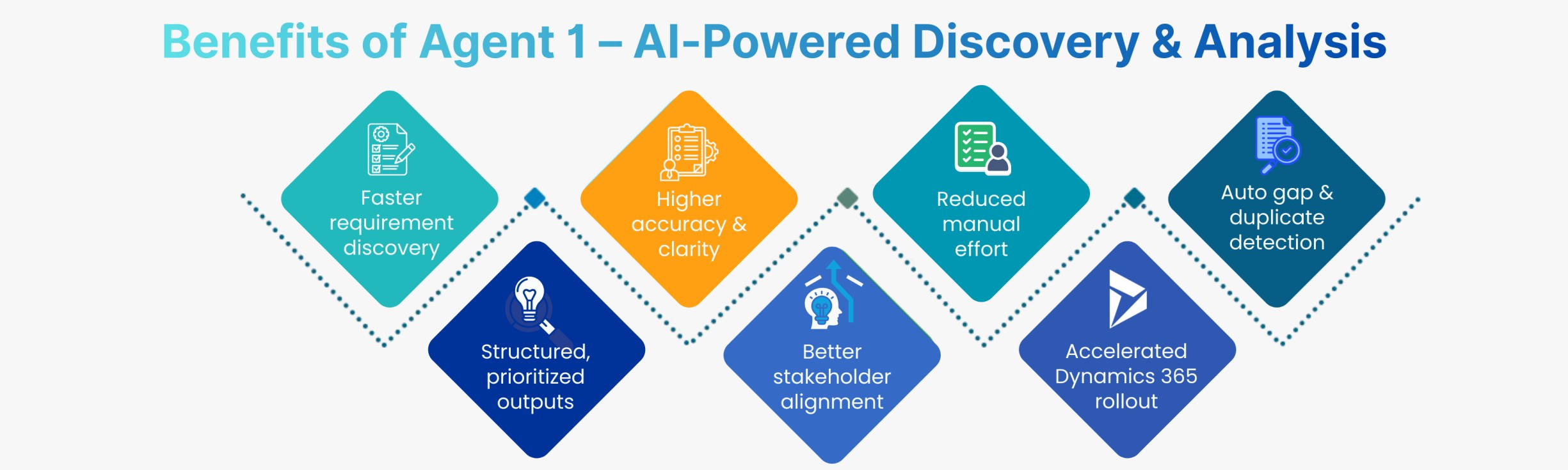
What Agent 1 is capable of can be measured in terms of the following benefits:
-
Requirements Gathering at a Higher Speed
For example, tasks that take weeks can now be done in a matter of hours. The timelines for discovery are greatly shortened by automated analysis.
-
Accuracy and Completeness
AI eliminates human errors, missed requirements, and misinterpretation.
-
Reduced Manual Effort
Implementation teams spend less time on documentation and more time on value delivery.
-
Collaboration Improvement
Requirements that are structured and organized optimize communication between the business and the technical side.
-
Successful Implementation Rate
Requirements that are clear and in priority order reduce the risks associated with the project and guarantee the deployments to run smoother.
Transforming ERP Implementation with AI
Agent 1 represents a move away from manual, document-oriented procedures to intelligent and automated requirements of intelligence.
Rather than depending on the traditional approaches and mechanism that delay implementation process, now an organization can benefit from:
- Automated requirement discovery
- Intelligent requirement grouping
- Faster readiness to implement
- Accuracy and clarity.
-
Improved project results
This allows businesses to fast-track ERP implementations with a check on alignment with business goals.
-
Real-World Impact: Accelerating Digital Transformation
Organizations adopting Agent 1 (henceforth) benefit from immediate improvements in implementation efficiency.
Implementation teams get;
- Quicker project start-up
- Requirement visibility
- Reduced risk of implementation
- Better stakeholder alignment
- Reduced time-to-value
This offers two benefits, first is that business stakeholders benefit from systems that reflect their reality, and second is that technical teams receive structured requirements.
The Future of Requirements Intelligence
And as organizations continue to adopt ERP platforms and digital solutions, intelligent automation will become an essential tool to use in managing complexity.
Agent 1 is the future of implementation of readiness with AI doing the analysis, organization, and optimization so teams can concentrate on innovation and delivery.
By coupling AI intelligence with implementation intelligence, Key Dynamics Solutions is helping businesses in redefining requirements for gathering, structuring, and delivery.
Conclusion
AI-Powered Discovery & Analysis agent is a strategic driver of faster, smarter, and more successful ERP implementations. Agent 1 is a transformational use of the requirements lifecycle by summarizing meeting inputs, extracting structured requirements, mapping business processes, ensuring no duplication, and prioritizing implementation tasks using AI.
Now, organizations can ensure accuracy and confidence as they move at a faster pace from discovery to implementation.
Not only does that intelligent approach speed up digital transformation, but it also guarantees that implemented systems are properly aligned with business needs, providing measurable value from day one.
Frequently Asked Questions(FAQs)
-
What problem does Agent 1 solve during project discovery?
Agent 1 accelerates the early stages of projects by collecting stakeholder inputs, analyzing documents, and identifying gaps or risks. It converts scattered information into structured insights so teams can start with clarity instead of assumptions.
-
How does AI improve requirement analysis compared to manual methods?
AI evaluates patterns across conversations, legacy data, and business processes much faster than humans alone. This helps uncover hidden dependencies, inconsistencies, and opportunities that might otherwise be missed during traditional workshops.
-
Can Agent 1 adapt to different industries or business models?
Yes. Agent 1 is designed to learn from industry-specific data and workflows, allowing it to provide relevant recommendations whether the organization operates in manufacturing, Retail Industry, finance, or services.
-
What outcomes can organizations expect from using Agent 1?
Businesses typically gain clearer requirements, reduced rework, faster project timelines, and more confident decision-making. By starting with intelligent insights, teams minimize risks and improve overall implementation success.
Please book a meeting with us from the link given in my profile’s bio. Or contact at: +919217719348. Looking forward to hearing back from you.